Coil cleaning quotes: define the task before adding the allowance
Clarify assessment, access, cleaning scope, compatibility and completion evidence when comparing a commercial HVAC coil cleaning proposal.
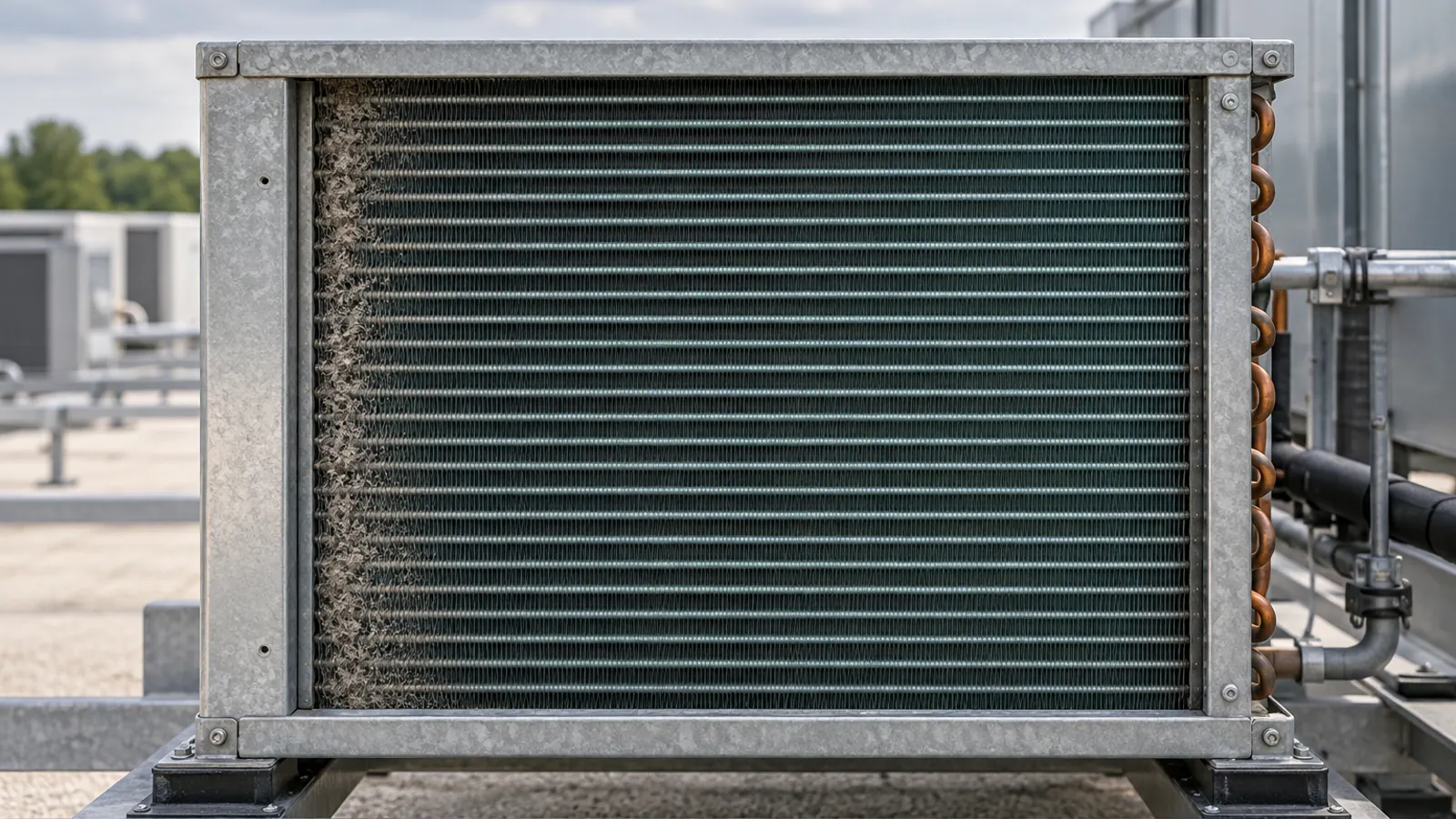
Inspection and cleaning are different scopes
A coil-cleaning allowance should come from a defined equipment-specific task, not from assuming that every maintenance visit includes cleaning. Ask the qualified service team what condition was observed, what work is proposed and why. This guide does not recommend a cleaning method, chemical or interval.
Identify the coil and asset clearly. A statement saying coils checked does not establish that cleaning was performed. Equally, a proposal for cleaning should not be accepted solely because it appears as a routine add-on. Request a condition-based explanation and check the manufacturer’s requirements with the people qualified to perform the work.
Ask what the quoted task includes
Clarify access preparation, protection of surrounding areas, the actual cleaning scope and restoration after work. Ask whether shutdown coordination, disposal and any specialist access equipment are included. Do not ask untrained staff to open equipment to obtain these details.
The contractor should explain how the proposed approach is compatible with the equipment and site. Record exclusions such as damaged fins, corrosion repair or unrelated faults. Cleaning is not a substitute for repairing a physical defect, and an improved appearance alone does not establish that a performance problem is solved. Have the qualified reviewer define the appropriate acceptance evidence.
Separate access from repeatable unit work
If several assets can be serviced during one mobilization, ask for a clear allocation of shared costs. A separate access allowance should not be added repeatedly when it covers one site setup. Conversely, do not assume a shared allowance applies when units require different access arrangements.
Illustrative arithmetic only: three hypothetical tasks at $300 each plus a $200 shared allowance total $1,100. These invented figures are not market prices or a recommendation to clean three coils. If the task is already included in the annual contract, the separate allowance may be unnecessary. Confirm the signed scope before adding it to the budget.
Define before-and-after evidence
Ask for asset identification, the observed condition, the completed task and any limitations. Where measurements are relevant, the qualified team should specify what to measure and under what operating conditions. Do not compare readings taken under materially different conditions without technical interpretation.
Photographs can support the record but should be connected to the asset and task. Avoid treating an unlabeled close-up as proof that all contracted equipment was serviced. If part of the work could not be completed, retain the exception and the proposed next step. A concise, accurate record is more useful than a generic statement that the entire system is now efficient.
Use a scope clarification table
| Question | Why it matters |
|---|---|
| Which asset and coil? | Prevents ambiguous quantities |
| What condition supports the task? | Connects work to evidence |
| What preparation and access? | Reveals shared and excluded costs |
| What method approval? | Keeps compatibility with qualified review |
| What acceptance evidence? | Supports completion review |
| What remains excluded? | Separates cleaning from repair |
If a proposal promises a specific energy saving, ask for the basis and verification plan. Do not accept an unsupported percentage as a budget offset. A useful cleaning task can be justified by equipment needs without inventing a financial outcome.
Reconcile the task with the annual agreement
After completion, update the service record and the remaining task schedule. Confirm that the invoice reflects the approved scope and any documented variation. If the same cleaning is proposed again soon, ask what changed and whether another cause needs investigation.
For the next contract, decide whether the activity should be included, separately priced or condition-authorized, with qualified input. Keep the decision explicit. The purpose of scope clarity is to buy the appropriate work and verify it, not to maximize cleaning frequency or minimize the annual fee regardless of equipment needs.
Handle a discovery during the task
Agree in advance how the contractor should report a condition that prevents completion. The report should identify the asset, the observation, the reason the original task cannot proceed and the proposed next step. A finding should not become an unlimited authorization to replace parts or enlarge the cleaning scope. Use the facility’s urgent-condition process where appropriate and its normal purchasing process for additional nonurgent work.
If the contractor proposes a variation, ask for the effect on cost, downtime and acceptance evidence. Retain the original scope alongside the approved change. This lets the invoice reviewer distinguish a justified discovery from an unexplained extra. If no variation is approved, record what was completed and what remains open. Do not accept a report that describes the entire task as complete when a material portion was deferred. The next budget should carry the unresolved work explicitly rather than assuming that the prior invoice closed it.
FAQ
Does preventive maintenance automatically include coil cleaning?
No. Read the actual task schedule and exclusions.
Can this guide choose a cleaning chemical?
No. Compatibility and method require manufacturer guidance and qualified technical assessment.
Does a before-and-after photo prove energy savings?
No. A photograph may show condition but does not establish a measured energy outcome.
Related decisions
- HVAC service records that support the next decision
- Repeated HVAC callbacks: investigate the chain, not just the invoice
- HVAC schedules and overrides: a low-drama operating review
- HVAC contractor handover: preserve the asset history
- Official HVAC maintenance sources: what each resource can answer
- Compare service arrangements
- Use the related planning tool
Sources and limits
- ENERGY STAR — Operation and Maintenance Best Practices — operating schedules, documentation and performance tracking; not price data.
Source links were checked during this implementation on October 30, 2026. Dollar examples are original illustrative arithmetic, not official prices. This guide is general planning information; building-specific technical, safety and compliance decisions require qualified review.